 |
 |
 |
Select your language
Choose your language


Principio di continuare il basso di Francesco Bartolomeo Conti
In 1724, Francesco Bartolomeo Conti was in serious difficulties preparing the carnival opera: a harpsichordist had resigned and left the court just a few weeks earlier, another harpsichordist was in Italy for advanced training in the latest style and the remaining harpsichordist had just cut his fingers in the kitchen at home with a cabbage slicer while preparing sauerkraut. The court music director Johann Joseph Fux is plagued by gout and can only play slow church pieces in contrapuntal style. So who is to accompany the singers in the latest opera, especially in the recitatives? Conti's only hope is a private student, but he is not yet sufficiently advanced in music theory and especially harmonics to be able to determine the correct harmonies from the parts, and he is still struggling with the wide variety of clefs used for the vocal parts. Fortunately, the young man, who actually works in the Hofkämmerei (i.e. in the court's finance department), is musically talented and otherwise quite clever – so the main problem is rather the type of notation he is unaccustomed to.
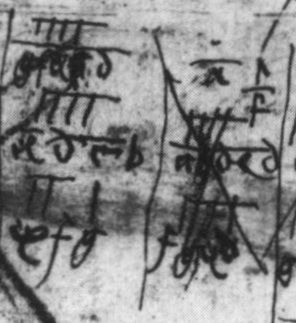
In order to save the performance, Conti quickly created his own musical “shorthand score”. An initial attempt based on the German organ tablature proved to be too complicated and was discarded by Conti:
Finally, Conti had the decisive idea of using the mathematical skills of the musically gifted bureaucrat and indicating the correct harmony in mathematical expressions above the notes for the left hand. The following notation can be reconstructed from the manuscript, which has only survived in fragments and is barely legible:

The performance was saved, Penelope was a great success and nobody, not even the critical and musically learned Emperor Charles VI, noticed that the harpsichordist was playing from a completely new and unusual notation.
Conti was so convinced of this method of notation, saving time, paper and ink, that he revised it during the musically not so busy Lent period and made it practicable for less mathematically adept musicians with a simple numbering system: the intervals are now directly indicated with ciphers from 1 (prime) to 9 (ninth), in exceptional cases also up to 12 (duodecimal) – these intervals are to be fingered from the right hand to the bass note of the left hand.
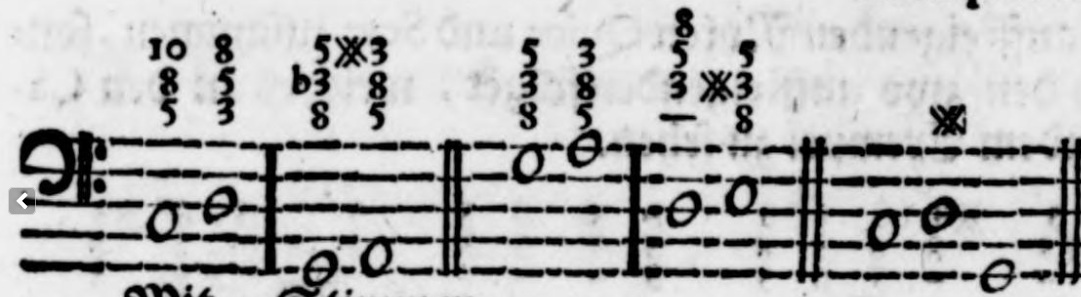
The result is a continuous bass in the harpsichord, a basso Conti-nuo. Due to the ambiguity of the word “continuo”, Conti's pioneering invention of this rapidly spreading principle has almost been forgotten – but thanks to the manuscripts that have now been rediscovered, including a draft for “Il Principio di continuare il basso”, Conti's previously unrecognized position in music history can be entirely reassessed – including possible cross-connections to his distant descendant Robert Conti (*1945 Philadelphia), who developed the jazz chord notation from Conti's continuo principle.
New, large-scale interdisciplinary research and practical projects at the GMPU will increasingly focus on these issues over the next few years.
1.4.25
Both performances from Penelope from Klagenfurt will be broadcasted in "Opernabend" of Radio Klassik Stephansdom on 26. March 26 (20:00; performance of 23.5.25) and 21. July 26 (20:00; performance of 24.5.25).
Radio Klassik can be received in Austria via digital radio and terrestrial transmission, as well as worldwide via online stream (https://radioklassik.at/programm/sendungsformat/16377/).
The program notes with a synopsis of the plot and the libretto texts (in Italian and German) are available on this website.
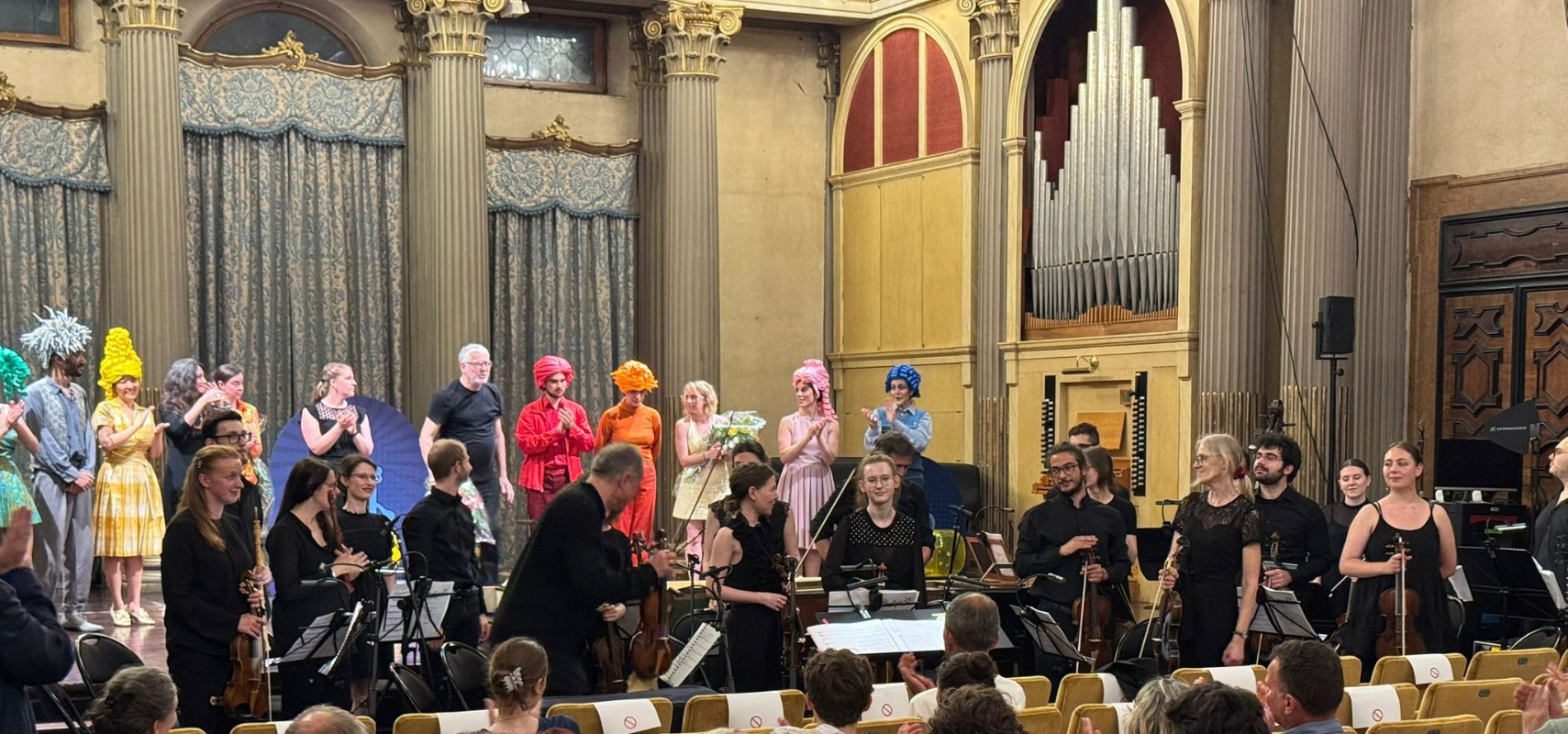
In contrast to the 20-year odyssey of Ulysses, the team from Klagenfurt and the external musicians made their way south to the Conservatorio di musica “Benedetto Marcello” in Venice to perform F. B. Conti's baroque opera Penelope together with the Venetian students for the last time. In addition to scores and instruments, the luggage also included stage elements, costumes, wigs, music stands, stand lights, gifts for the colleagues in Venice and great joyful anticipation of the reunion and making music together.
From "Wienerisches Diarium" to a multimedial report
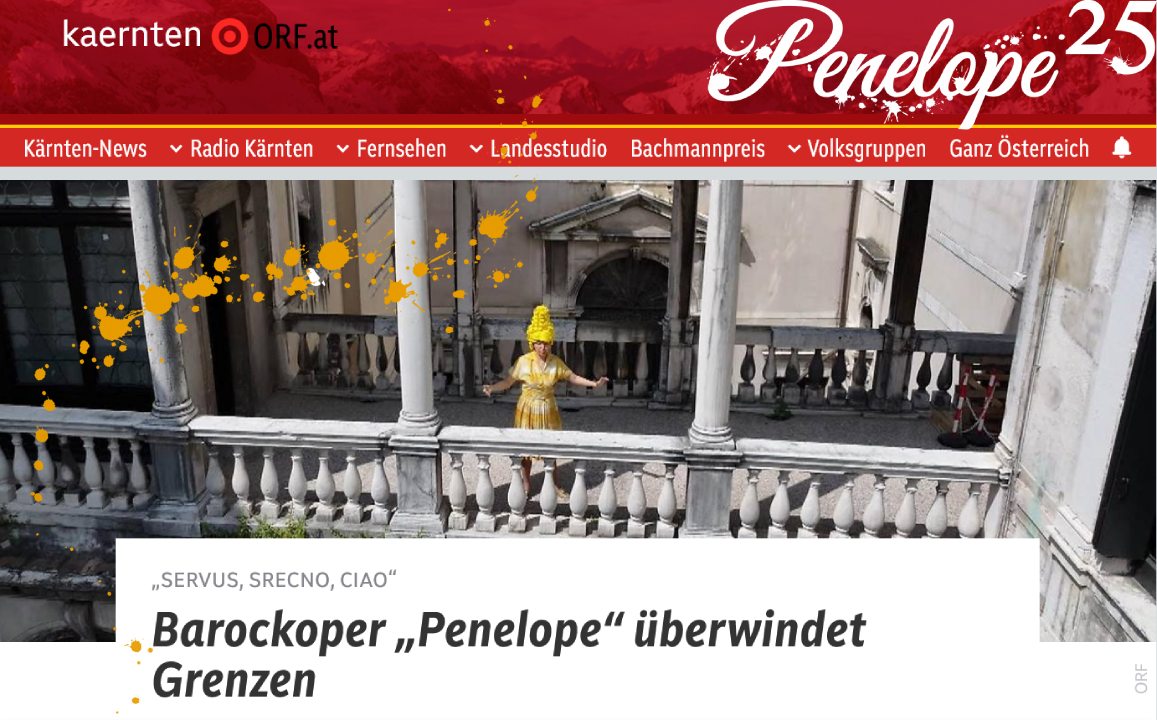
Emperor Charles VI and F. B. Conti would also have been pleased: In 2025, the Venice tour of PENELOPE 2025 was documented by the ORF camera team, while in 1724, the audience of the newspaper Wienerisches Diarium was provided with information concerning the plot and Penelope remained a local production for the carnival festivities in Vienna. A report in “Servus, Srecno, Ciao” provides insights into the transfer of the production to Venice and the cross-border collaboration between the two institutions. Students also share their experiences in an interview. We would like to thank Iris Hofmeister (ORF) and her team for this impressive review of the project.
PENELOPE 2025 – Baroque Opera communicated
Lecture in the series "Forschungsforums" at the GMPU, 24.6.2025, 17:00–ca. 18:00h, Blauer Saal
Ramona Hocker, Helmut Schaumberger, Theresa Aichner und Cornelia Faber
Read more: Baroque opera communicated: Forschungsforum 24.6.25 at GMPU
Following the performances in Klagenfurt, F. B. Conti's Tragicommedia per musica Penelope will be performed on June 14 at 6 p.m. in the concert hall of the Conservatorio di musica “Benedetto Marcello” in Venice.
This is the last opportunity to enjoy the production PENELOPE 25, created in cooperation between GMPU Klagenfurt and the Conservatorio di musica in Venice! The cast of singers differs from the two casts of the evening version in Klagenfurt, so that a unique version of the work will again result from the interaction of the performers.
8 characters, 14 singers, 26 instrumentalists, 2 conductors, 23 editors, 13 music educators, 5 music pedagogues, 1 composer, 3 stage directors, 5 video- and audio technicians, 1 light technician, 1 stage designer, 1 make-up artist, 1 taylor, 2 translators and a big number of collegues at the GMPU Klagenfurt, the Konzerthaus Klagenfurt and the Conservatorio di musica "Benedetto Marcello" in Venice, who were active around the production and next to the stage: